
Didinium: The Tiny Predator That Swallows Prey Bigger Than Itself
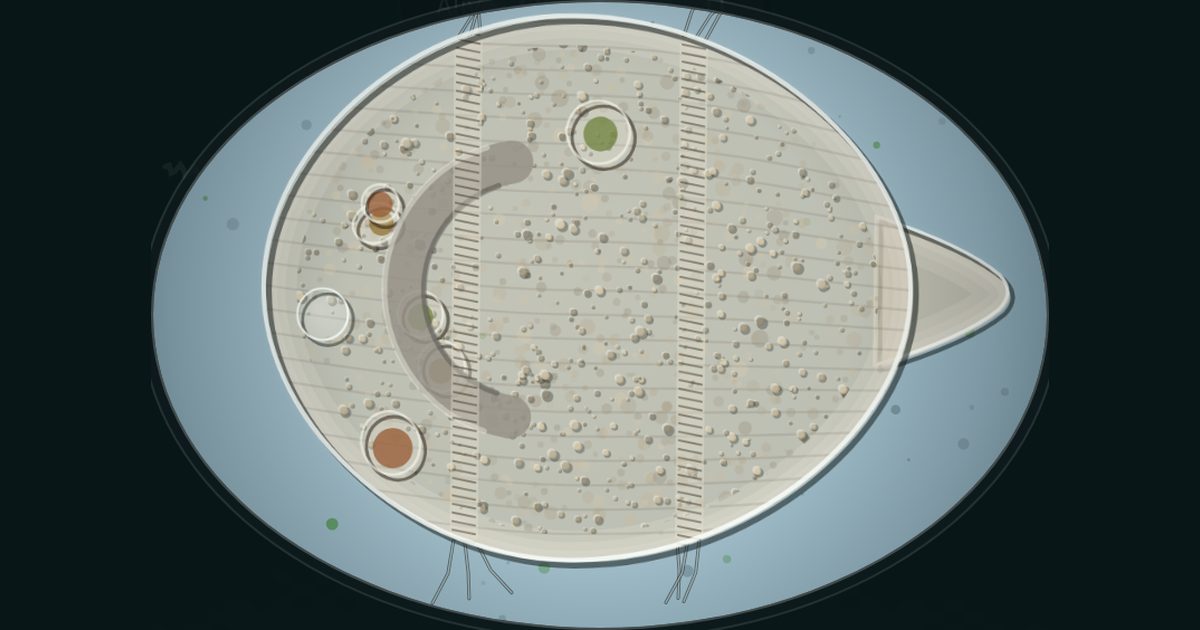
Most microbes eat things smaller than themselves. Didinium (Didinium nasutum) did not get the memo. This barrel-shaped hunter, about 80 to 200 micrometres long, regularly swallows paramecia that are bigger than it is.
A spinning barrel
A didinium looks like a small barrel with two belts of cilia wrapped around it. The belts row it through the water while it spins on its long axis. It does not seem to steer toward a target. It cruises around and strikes the instant its pointed snout, the proboscis, touches prey.
Poison darts and sticky darts
The tip of the snout is armed. When it touches a paramecium, the didinium fires two kinds of tiny projectiles:
- Toxicysts, poison darts that paralyze the prey.
- Pexicysts, sticky darts that hold on to it.
The paramecium may fight back with darts of its own, but once a didinium has a firm grip, the struggle is usually over.
Swallowing it whole
Now comes the part that looks impossible. The didinium’s mouth stretches open like a balloon, and over a few minutes it swallows the paramecium whole, even though the prey is larger than the predator. Digestion takes hours, and the didinium swells up like a stuffed sack while it works.
A single didinium can eat more than ten paramecia in a day.
Sleeping through hard times
When there is nothing left to hunt, a didinium does not simply starve. It builds a protective shell called a cyst and goes dormant until conditions improve.
Be the hunter (or escape it)
In Micro Pond, the didinium is the hunter you learn to fear early on. It chases anything it can eat, including you, and lunges when it gets close. If it is clearly bigger and grabs you, you have a moment to dash free. Evolve into a didinium yourself and the tables turn: you hunt prey up to your own size and tear off bites to eat faster.
Sources
- Encyclopaedia Britannica, "Didinium"
- Berger, J. Feeding behaviour of Didinium nasutum (1979)