
Paramecium: The Slipper That Rows With Thousands of Oars
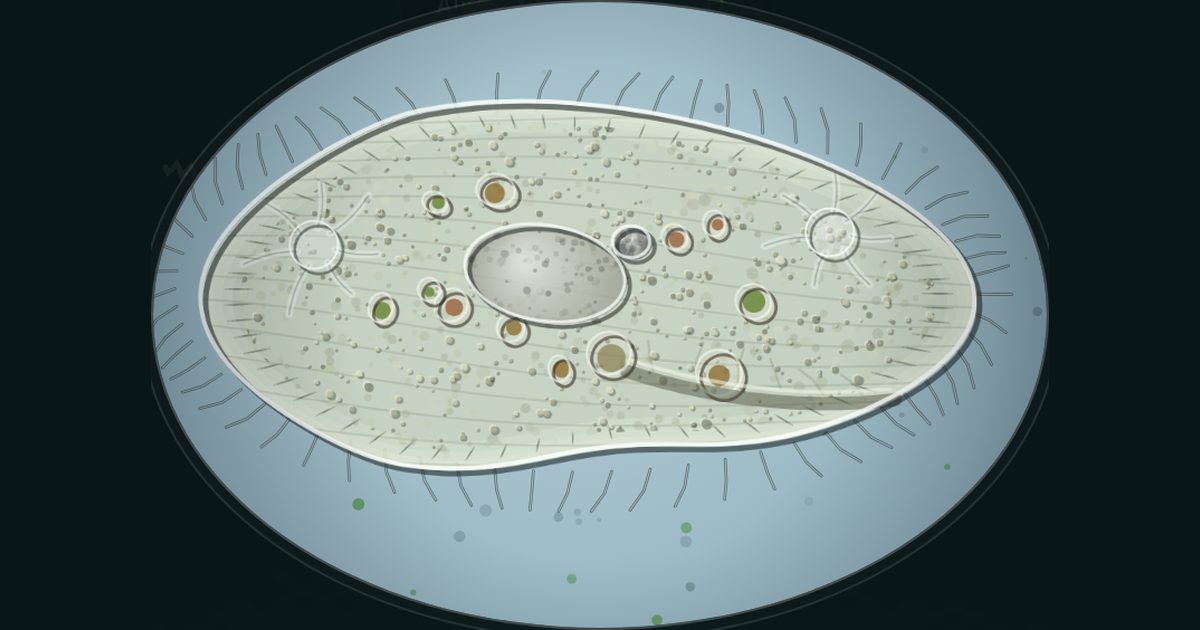
If the amoeba is the pond’s slow, flowing blob, the paramecium (Paramecium caudatum) is its sprinter. Shaped like a little slipper, about 170 to 330 micrometres long, it zips through the water so fast that it can be hard to follow under a microscope.
Thousands of oars
A paramecium is covered in thousands of hair-like cilia. Each one beats dozens of times a second, and each beats a tiny bit later than its neighbour. Together they make ripples that travel along the body, called metachronal waves, a bit like a stadium crowd doing the wave.
The cell twists as it swims, so it moves forward in a corkscrew at about 1 mm per second. That is several times its own body length every second.
Back up, turn, try again
Paramecia are famous for the avoiding reaction. When one bumps into a wall or an obstacle, a calcium signal flips the beating of its cilia, so it suddenly swims backwards. It then turns a little and heads forward again. Bump, back up, turn, try again, until it finds a way through. It is one of the simplest examples of “behaviour” in a single cell.
Dinner on a conveyor belt
Along one side runs a groove called the oral groove. Cilia inside it sweep water, bacteria and yeast toward the cell’s mouth. Each mouthful is wrapped in a food vacuole, which then travels around the cell on a fixed route while it digests. Leftovers leave through a fixed exit, the cytoproct, a kind of anal pore.
Self-defence darts
Paramecia have enemies, especially the barrel-shaped predator Didinium. When attacked, a paramecium can fire thread-like darts from trichocysts along its edge to try to push the attacker away.
Two nuclei
A paramecium has two kinds of nucleus. The big macronucleus runs the everyday work of the cell, and the small micronucleus handles reproduction. When it divides, it pinches across the middle into a front half and a back half.
Be the paramecium
In Micro Pond, paramecia are fast, skittish snacks: they flee from anything bigger than themselves, so you have to corner them against a rock or dash. Evolve into a paramecium yourself and you get its speed, a mouth that sucks in nearby food particles, and a tough body that rocks cannot tear.
Sources
- Encyclopaedia Britannica, "Paramecium"
- Wichterman, R. The Biology of Paramecium (1986)